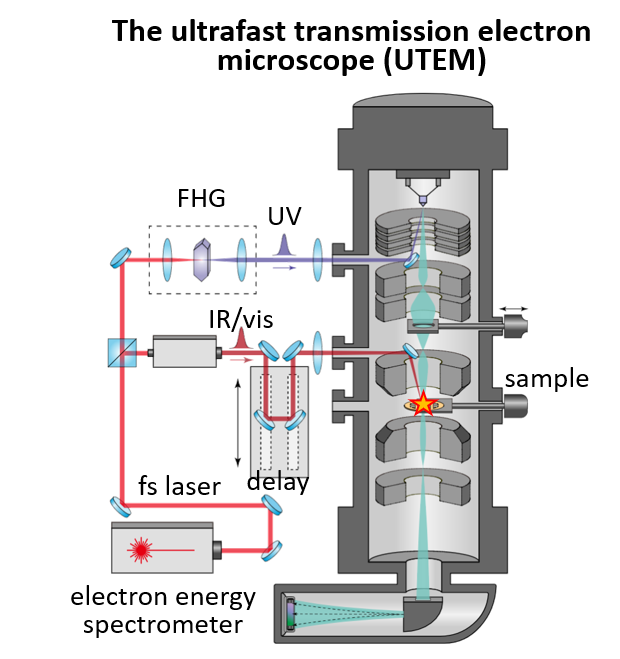
Superradiance in an Electron Microscope
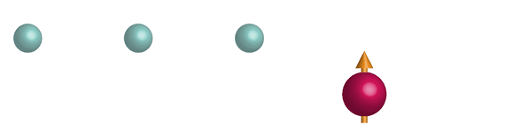
Interactions of a free electron and quantum emitters When a free-electron passes near a quantum emitter, its monopole can interact with the dipole of quantum emitters, and can drive a transition.
Superradiant Cathoduluminecence Cathoduluminecence is the emission of light from fast free electrons, we are looking to shape the wavefunction of free electrons to make them “bunched”, and cause their field to have a distinct frequency component, allowing them to coherently drive a transition in a quantum emitter.
We utilize either nitrogen vacancy centers or silicon vacancy centers in diamond.
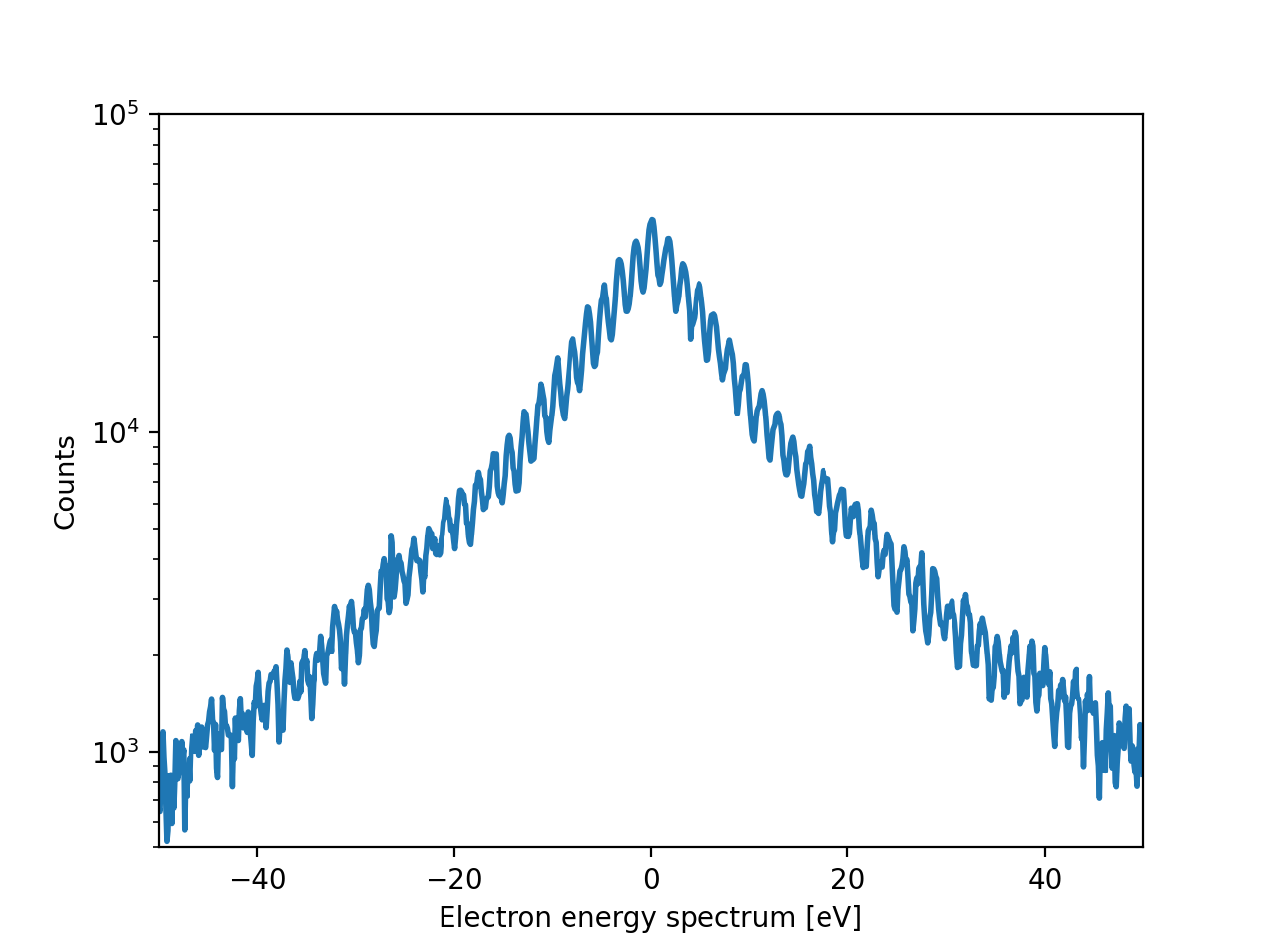
Quantum emitter superradiance Many quantum emitters are excited by a laser from a specific angle, and then a free electron passes by the emitters and interacts with them. The velocity of the electron is chosen such that the electron-quantum emitters interaction is phase-matched and scales as the number of quantum emitters squared. Hopefully allowing us to observe it in the electron energy spectrum.