Survival of Giant Density Clumps Against Disruption by Supernova Feedback
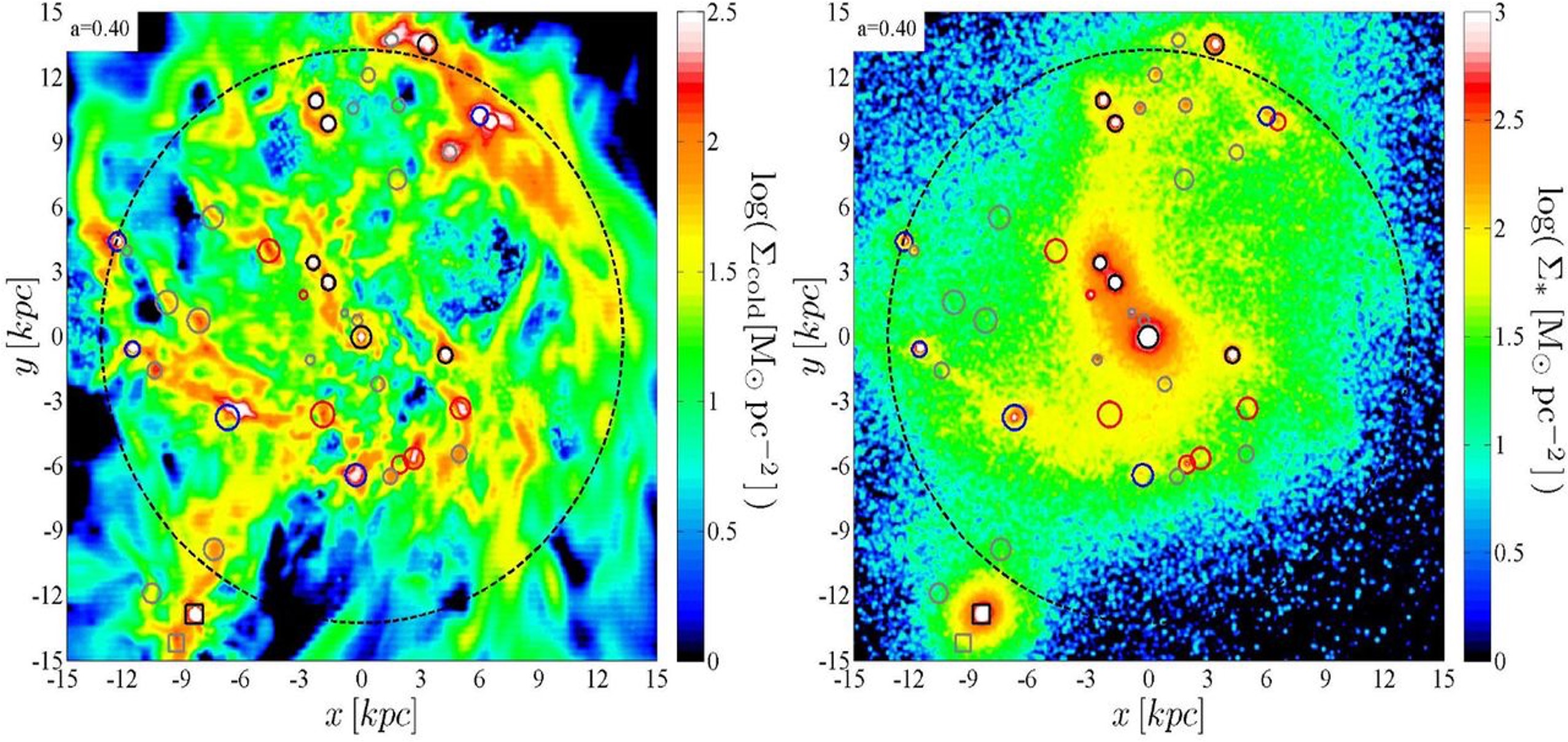
Many galaxies at high redshift are clumpy, meaning they have areas that are overdense compared to the sorroundings. Clumps are formed when the force of gravitation overcomes the forces due to pressure and rotation causing a local inward collapse of mass. Below is a snapshot from a simulated galaxy in the Vela simulation suite (figure from Mandelker et al 17) the clumps are marked with circles:
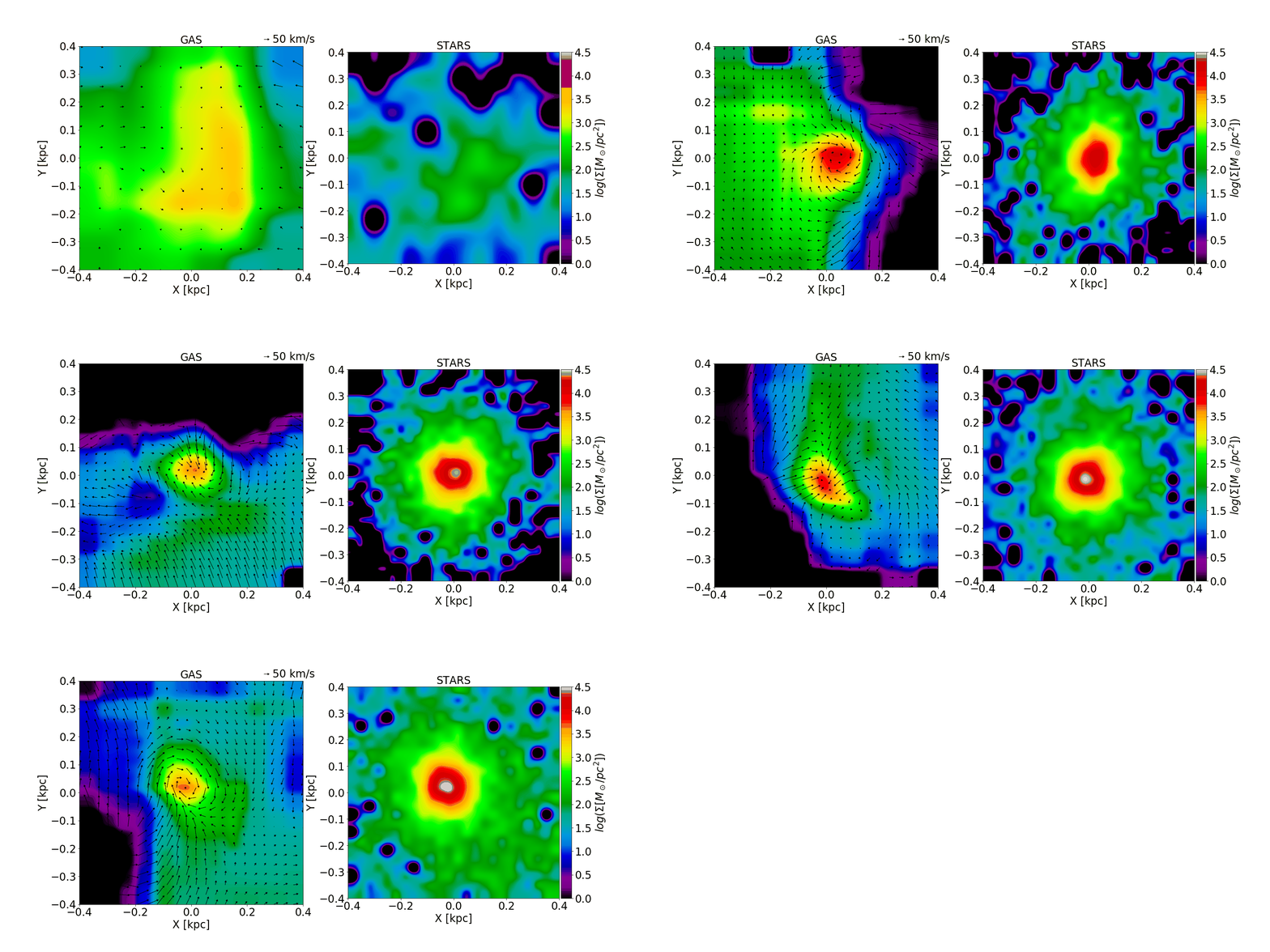
Studying massive clumps in high redshift, we look into the survivability of clumps. Some clumps are relatively short lived, disrupting over a few Myr while others are long lived living for hundreds of Myr. The goal of the project is to understand what determines the fate of a clump, whether it will be short lived (SLC) or long lived (LLC). We use a combination of analytical modeling and data analysis of pre-existing heavy numerical simulations. We take into account the feedback from supernova. Here is an example of a simulated clump evolving in time and converting its gas into stars.
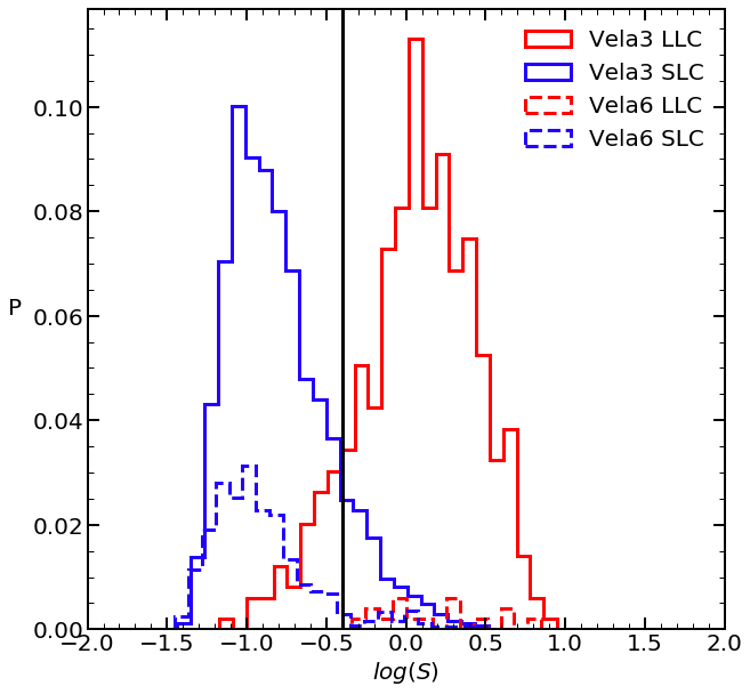
Our theoretical model compares the energy input by supernovas in the clump to its gravitational binding energy. We define a quantity S, the ratio of the gravitational to supernova inputed energy. According to the model, if S is smaller than a criticle value ~0.5, the clump’s gas could be lost by outflow. Below you can see the distribution of the S parameter in the Vela simulations (Vela 6 having increased feedback), the value of S=0.5 splits the long lived and short lived clumps.