
Soliton Interactions
Solitons are localized waves that retain their shape during propagation. They are formed due to a delicate balance between nonlinear and dispersive effects. Optical solitons interact through different mechanisms and can form bunches, sometimes the seperations between solitons in these bunches are orders of magnitude longer than their width. Here is an example of a soliton bunch with the soliton separation and number changing due to a decrease of the energy available.
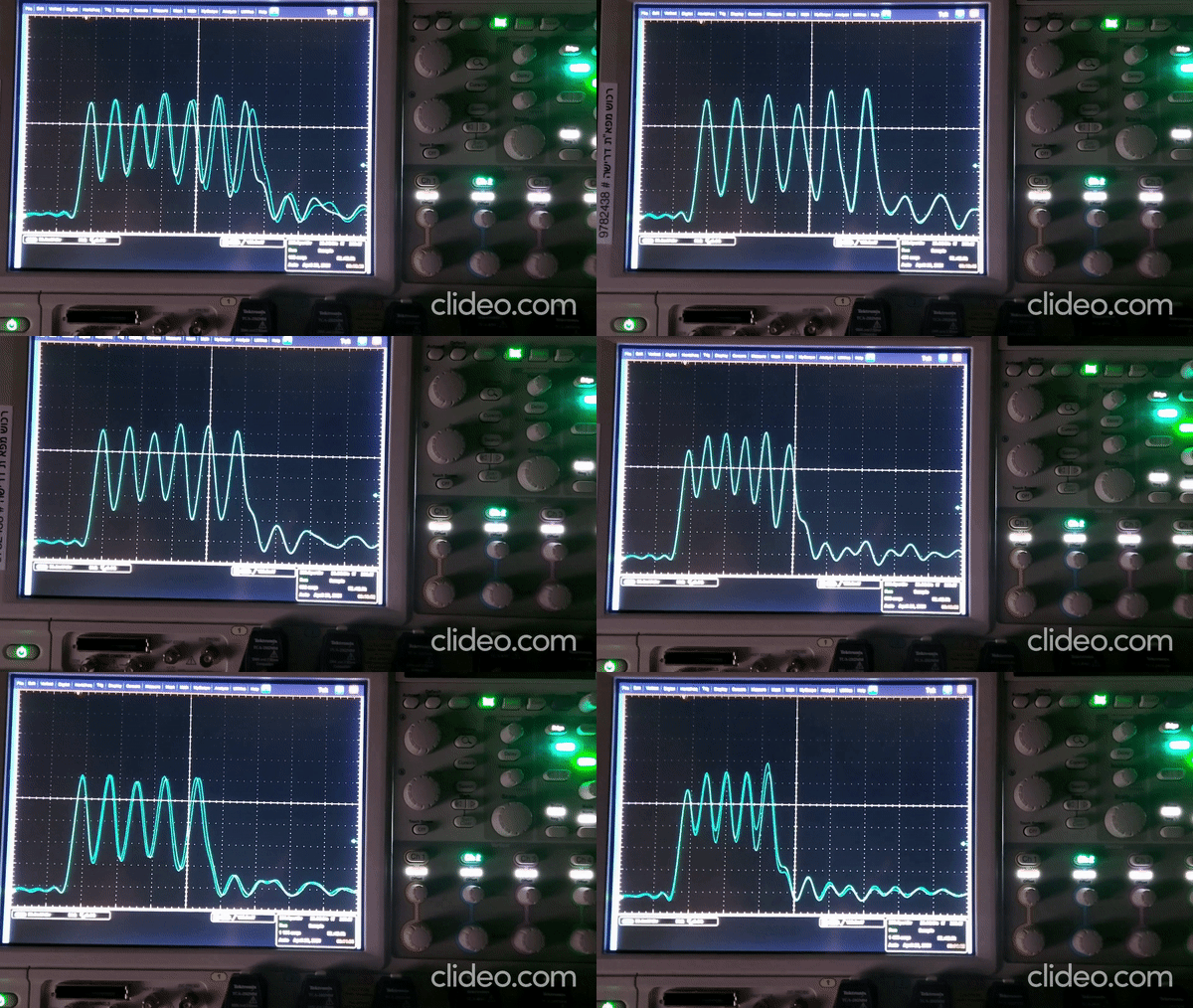
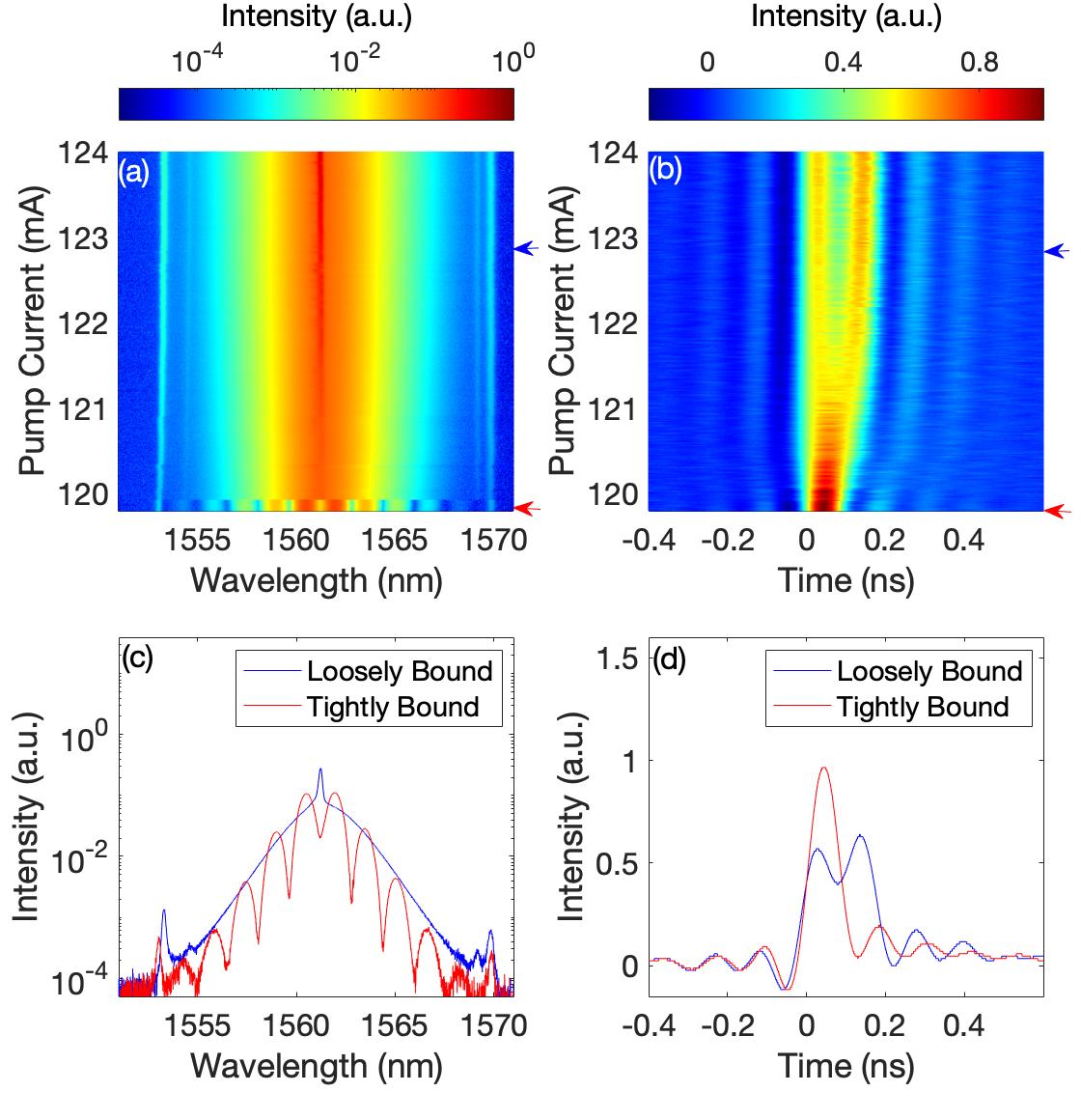
Although the solitons look as if they are overlaping, in truth this is due to the limited resolution of the oscilloscope. They are actually separated a distance roughly 100 times their width, we call this type of soliton bunch “loosely bound”. The solitons are bound through a noise mediated interaction (NMI). The second type of interaction happens at close range, where the soliton seperation is on the same scale of the soliton width, this kind of soliton bunch is called “tightly bound”, and is bound by a coherent interaction. The solitons in this case interfere and fringes can be seen in the spectrum. Down below we demonstrate the two binding mechanisms and a transition between them.
In this project we model the steady states due to NMI and compare to experimental results. The solitons are modeled as particles conducting Brownian motion in a medium were the diffusion coefficant depends on the different pulses’ location. If you would like to know more, you can read our paper on this work here